
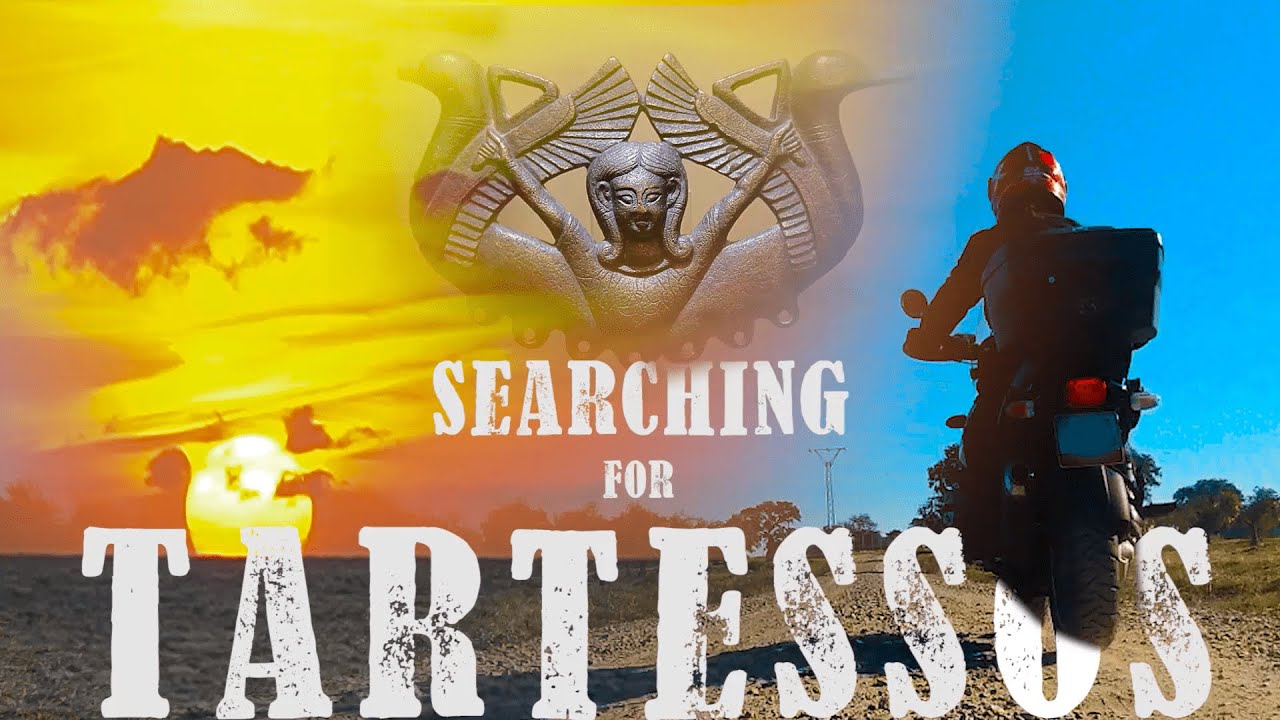
Searching for Tartessos (supporting document) – Originally Published: Cordoba, December 2021
“It was a great and wealthy city
In ancient times. Now it is poor, now it is small,
Now it is forsaken. Now it is a heap of ruins.”
– Avienus
Six centuries before Julius Caesar and the sons of Pompey clashed in civil war and washed these lands in Roman blood, fifteen centuries before the golden age of Al Andalus, when these cities bustled and thrived as beacons of art and science in early medieval Europe, and nearly three thousand years before millions of people today live, work, and socialize on these streets, oblivious to what lies beneath their feet, these lands, and its people, were legendary. They were spoken of throughout the known world, renowned for their immense wealth and prestige, and the kingdom that ruled over it all. Tartessos.
Or so the story goes. Here we are in the city of Huelva, the proposed site for the lost city of Tartessos. Well, one of the proposed sites for such a city, which is itself perhaps a supposition. Most of us outside of Spain haven’t heard of Tartessos, but here in southwest Andalucía, well…
Tartessos hasn’t existed for twenty-five hundred years, but in the south-west corner of Spain its presence has never been greater. Here Tartessos persists as mystery, as history, as identity. Here, the story of Tartessos is far from finished. It is a story of a lost people, and of their legacy. But is also a story of ourselves; our misunderstanding, our mishandling, and our manipulation of history. So join me as I bike across this beautiful part of the world in search of that story. Welcome to searching for Tartessos.
Sometime during the eighth or ninth centuries of the 1st millennium BCE (1), whilst the neo-Assyrian empire insatiably expands in the near east, and Phoenician sails decorate blue Mediterranean waters from the Levant to Libya and beyond, whilst confident Hellenic city-states look beyond the horizon and Etruscans war and feast in a world blissfully ignorant of an insignificant mud-hut village on a small hill on the east bank of the Tiber, far away, on the other side of the known world, a group of children are playing in the cool Atlantic surf when suddenly, silently, a single solitary vessel emerges from behind the headland.
1) all dates are BCE, unless otherwise stated.
Our story begins with that classic love triangle of an Englishman, a German, and the 20th century. The late 1800’s/early 1900’s were the golden age of archaeology. With every passing year, more ancient sites were rapidly identified and excavated across Europe and the near east. Cities long lost to antiquity emerged from the fringes of mythology to be revealed, scrutinised, and claimed by modern Europeans. Ur, Knossos, Mycenae, Troy. Suddenly, the legends of antiquity had become tangible. Archaeology fever had taken hold of Europe, as it had taken hold of our two unlikely protagonists.
George Edward Bonsor was a British historian (and painter) who lived in Seville for about fifty years until his death in 1930. During that time, he conducted many significant excavations of Tartessic and Roman sites culminating in a ground-breaking publication that laid the foundation for the future study of Tartessos. After years of research, Bonsor was confident he had finally located the long-lost city. All he needed was a team, and some money. Enter Adolf Schulten, a German archaeologist with a number of digs in Spain under his belt, most famously that of the Celtiberian city of Numantia. Equally captivated by the lure of Tartessos, Schulten approached Bonsor and together they set off in search of the lost city. Armed with the wealth of Bonsor’s knowledge and the wealth of Schulten’s wealth (sponsored by Kaiser Wilhelm II) they pinpointed the location of Tartessos to right here, Cerro del Trigo in the Doñana National Park, a stretch of wetlands and shifting dunes on the Atlantic coast between Cadiz and Huelva. After weeks of exhaustive work, just when Bonsor and Schulten were at their wits end and at each other’s throats, this is what they found. Nothing.
Until well into the 20th century, Tartessos hunters obsessed over the elusive lost city. With little material evidence to point to, they clung to passing references in ancient sources and read, one might say, a little too deeply into them. Over the centuries a fantastic image of Tartessos was carefully concocted around these sources. It was vast and wealthy kingdom beyond the pillars of Hercules, where a civilised and cultured people resided. They invented writing in Western Europe and maintained a sort of proto-Spanish empire. It was a handy legend to evoke if you were, say, the first Catholic Monarchs ruling over a newly unified Spain and looking to legitimise the wealth and supremacy of your divine monarchy, or a new dictator searching for a unified ‘glorious past’ to whitewash the cracks left by a brutal civil war. Or even if you were an Iberian born noble living in the savagely racist and classist upper echelons of imperial Rome, desperate to confer some mythical ancestry onto your pedigree.
Of course, it helped that the earliest surviving sources referencing Tartessos are predominantly archaic and classical Greek texts, thus Tartessos took on a falsely Hellenic character in the cultural consciousness. This struck a chord with savvy Romans wishing to be identified with such sophistication and prestige rather than being seen as just another provincial “Iberian”. It suited Ferdinand and Isabella too in their war against the Moors of Al Andalus and their cultural expungement of anything remotely African or “Semitic”. And during the Franco regime’s purging of non-Celtic “Iberianness” from the new state-determined unified racial ancestry, Tartessos was not only excused, but exploited to highlight Spain’s historic and modern right to greatness and power. Of course, that was all rubbish, and even in Franco’s time there were some scholars brave enough to say well actually…
But so long in the absence of archaeological evidence, and in the face of the worst of 20th century ideology, is it any wonder that the legend of Tartessos persisted as long as it did? But what exactly did Bonsor and Schulten expect to find here? How did they come to the conclusion that there was a lost city buried beneath these marshlands? And how come we’re even talking about Tartessos at all?
The earliest mention of Tartessos is found in a fragment from Stesichoros’ ‘Geryoneis’, a poem about Herakles’ encounter with the three-headed monster Geryon. It dates from the 7th – 6th century, and in it Tartessos is named as a great river near the land of Erytheia, that is to say in the region around modern-day Cadiz. That river is likely the Guadalquivir, this river. The Romans called it Baetis, and it has been the constant backdrop and lifeblood of this region for millennia.
Tartessos appears next in the late 6th century writings of the pioneering geographer Hekataios of Miletus, and again a little while later in the Histories of Herodotus, dating from the latter half of the 5th century. This time however, Tartessos is described as a wealthy kingdom, ruled over the magnanimous King Arganthonios. In the Histories, Herodotus relates the story of an expedition of Phocaeans (Ionian Greeks from the western coast of Anatolia, modern day Turkey) who ventured west, beyond the great pillars, and encountered the kingdom of Tartessos. There they befriended the so called Arganthonios who, Herodotus relays, reigned for 80 years, and lived for 120.
But more impressive than the improbable longevity of the ruler of this land was the wealth he possessed. After hearing of the Phocaeans’ struggles against an expanding Persia, Arganthonious invited them to settle in Tartessos, in any place they chose. But they refused, so instead Arganthonious gifted the Phocaeans a boatload of cash to erect a great wall around their home city to withstand the Persian assault. All of this occurs about a century before Herodotus’ time, roughly in the mid-6th century.
So by then, Tartessos was already known about in the Greek world, even if in a semi-mythical sense. We have an excerpt from that time by a Greek poet called Anacreon, who was, judging by his drinking songs, what we would today call an absolute legend. You get the sense the party only really started when Anacreon pulls off his tunic, yells shots, jumps on the table and proceeds to drop some rhymes. Regardless of what was going down in 6th century Samos and Athens, which was definitely not YouTube appropriate, this particular killer rhyme goes: I myself would not want the horn of Amalthea, nor for a hundred and fifty years to be King of Tartessos. Probably sounds better in Greek. The point is this random mention of Tartessos and its unnamed king is poetic allusion; it is assuming that the 6th century Greek audience knew to whom and what the poet is referring: a fantastically long-reigned ruler of a fantastically wealthy land. This single surviving line is an invaluable echo of 7th/6th century Tartessos, a Tartessos in its prime.
So this is what Bonsor and Schulten expected to find in the Doñana national park: a Tartessos in its prime. A great polis in the Hellenic style endowed with grandeur and splendour as referenced to in the ancient sources. But they were sorely disappointed. With their relationship souring and frustrated at their lack of success, Bonsor and Schulten abandoned the Doñana dig and parted ways. But unwilling to admit defeat, Schulten fabricated one of the most damaging theories to explain Tartessos’ persistent elusiveness. It was, he suggested, non-other than the lost city of Atlantis.
The Tartessos-Atlantis connection persists to this day. Google Tartessos and I guarantee within a few clicks you’ll be reading some version of Plato’s notorious myth. However, we should not judge Bonsor and Schulten. We can only exist within our times, and we can only work with what we’ve got. It just happens that the times Bonsor and Schulten existed in coincided with politically driven theories of race and nationality, and what they had to work with was a jumble of inconsistent and incomplete sources. Dealing with the sources first, we must understand that whilst Tartessos vanished, the name did not. It stuck around for centuries, popping up in histories, geographies and periplus, which are texts documenting coastal geography and ports, kind of like an ancient travel blog. Bonsor and Schulten relied heavily on a work called Ora Maritima by Avienus. It’s a 4th century CE poem in the style of a periplus, though I certainly wouldn’t want to navigate by it. It describes the coastal geography of Iberia with, shall we say, poetic license. But in the early 1920’s, and today on websites of dubious historical credibility, it is one of the most referenced and quoted texts describing Tartessos. The opening lines at the start of this video are a quote from the Ora Maritima, but beware: although often associated with Tartessos, the passage from which the quote comes actually describes Gadir, modern day Cadiz. So, in general, be careful what you read on the internet. Anyway, Schulten had no doubts about Avienus, and despite it’s literary over its historiographical and geographical merits, Schulten was convinced the Ora Maritima contained versified passages of a 6th century BCE periplus, which is somewhat doubtful. And this is just one in dozens of sources which mention Tartessos as one entity or another and in varying locations. Bonsor and Schulten spent much of their lives searching for some evidence, some fragment of verification of the existence of the lost kingdom, and they didn’t know how close they’d come. In fact, they’d already found it – they just couldn’t see it.
The early 20th century was cursed by the rise of extreme political ideologies. Increasingly volatile beliefs as to whom and why the modern age belonged infiltrated homes and factories, schools, palaces, and parliaments across Europe. Ultimately, it led to destruction. But for a brief period, the western European nations, confident in their rightful supremacy over all other peoples, sought to explain their inherent greatness as descendant from the proud, noble, and unconquerable peoples of ancient times. In Italy, a resurgent obsession with a cherry-picked past of the glorious Roman empire barely hid the guiding hand of fascism. Germany evoked its Aryan purity, France it’s proud Celtic heritage. But whatever their chosen mask, the face behind was the same, and it looked upon the world from its position of power, of superiority to all others for they were Indo-European.
This is wrong on so many levels, and thankfully it has mostly fallen from favour. But for a time, the rush to associate anything with an Indo-European identity had disastrous consequences for history and archaeology, amongst many other things. In Spain it meant the labelling every new archaeological find as being Celtic or Roman unless it was undeniably Punic. Celtic and Roman was desirable, Punic was not, because Punic meant Semitic, north African. Punic refers to the Phoenicians and their later heirs known as the Carthaginians. And since we’re here in the city of Cadiz, lets properly introduce these awesome seafarers into our story.
… a single solitary vessel emerges from behind the headland. It is a behemoth of glistening wood and rope, forcing apart the waters with its great rounded bulk. Like a colossal whale it heaves its heavy mass through the crest of a wave, its billowing stripped sail empties the wind from its belly as the magnificent carved prow turns to follow the shape of the shoreline. Now like a nimble water insect propelled by a synchronised rank of oars, it glides towards the shallows. The children, momentarily transfixed, break for the dunes as a second, then a third ship follows around the headland. The Phoenicians are here.
Phoenician is the term we give to the Semitic-speaking maritime city-states in modern-day Lebanon and Syria from roughly 2500BCE, reaching their height in the early 1st millennia, before gradually fading in relevance in the latter half of the millennia. It is a cultural and linguistic group that encompassed the politically independent city states of the Phoenician Levant such as Tyre, Byblos and Sidon. And as a result of their pre-eminence as maritime traders, their culture spread across the Mediterranean, anchored by numerous and largely autonomous colonies. Carthage, established around 814 BCE by colonists from Tyre, is of course the most famous Phoenician colony, but another is right here: Cadiz, or as it was named then, Gadir. Established around the turn of the millennia by colonists from Tyre, the colony thrived. Other Phoenician colonies were established further east, notably modern-day Malaga. From these centres of trade and commerce, Punic goods, technology, and culture heavily influenced the societal development of southern Iberia. Keen to exploit the mineral richness and agricultural prospects of the land, the small Phoenician populations found keen partners in the indigenous societies, ready to capitalise on the Phoenicians prominence in the Mediterranean market.
This is how Tartessos gets its start. Colonisation is a term that carries a lot of baggage. But when we talk of Phoenician colonisation, we mustn’t picture invasion, subjugation, and large-scale cultural replacement. These were small groups of traders, craftsmen, farmers, living in small urban centres such as this one at Doña Blanca just north of Cadiz. Yes, they spoke a different language, followed a different religion and culture, but then as now one thing is understood as being more important than all of that, the great unifier – money. So long as the Phoenicians brought wealth, goods, and innovation in return for resources, labour, and peaceful co-existence, everybody profits. Gradually, cultural exchange occurs. The lines become blurry and before long, we see the emergence of a distinct cultural identity manifesting itself though goods, architecture, art and religion. Nowhere was this as successful as on the south-western Iberian coast were, following contact with the Phoenicians, an entirely unique culture blossoms.
And this is what Bonsor and Schulten simply could not see. There wasn’t no archaeological evidence. Their respective ideologies had narrowed their vision to such an extent that they failed to realise they were holding in their hands the very thing they were searching for. In their search for the Tartessos of legend, they dismissed the artifacts they were unearthing as being Celtic, Punic, or, bizarrely, Celto-Punic. In his campaign to keep Tartessos culturally untarnished by eastern, Semitic influence, Schulten went so far as to blame the Phoenicians for the disappearance of an Indo-European Tartessos, resulting, in his eyes, to the corruption and degradation of subsequent iron-age Iberian cultures. Swept up in the prevailing ideological winds of his times, it would not be until 1958, two years before Schultens death at the age of ninety, that a chance discovery would finally crack the impenetrable ice that had for so long encased the Tartessic mystery. After so many years of dead-ends and frustration, the excavations at El Carambolo were the shot in the arm researchers needed, and what a shot it was.
This is the treasure of El Carambolo. It is a collection of gold artefacts dating to the 8th century but deposited in the 6th. They were found in a ceramic pot by construction workers in 1958. The artefacts are manufactured in the Phoenician style with locally mined gold. Whilst initial hopes at the finding of the lost city were dashed with further excavations, the discovery of the Carambolo treasure marked a turning point in the academic approach to understanding Tartessos. Beginning around the later 8th century, eastern imagery and decorative styles spread westwards across the sea. In Greece, Italy, and now Iberia too, oriental motifs and decoration are adopted as cultural and material exchange with the near east becomes entrenched, thanks in no small part to the stable trade of the Phoenician colonies. This is the orientalising period, and Tartessos emerged slap bang in the middle of it.
It wasn’t quite an ‘ah-ha’ moment. Like the orientalising process itself, acceptance of Tartessos as an orientalised, even hybridized culture took time. At the time of Phoenician colonisation, an existing indigenous culture was already established here in Huelva, exploiting the raw mineral resources, trading along the Atlantic coast, even trading with the Phoenicians pre-colonisation. Nevertheless, newly arrived Pheonician individuals and families from Gadir and beyond probably set up shop midst this indigenous population, further adding to the social complexity. Here, we see the beginnings of a fruitful relationship between the local population and the eastern settlers, who, in time, would contemporaneously expand along the Guadalquivir and Guadiana rivers to farm, manufacture and trade with the Iberian interior. Settlements such as at El Carambolo and Carmona formed a cultural and economic nucleus, concentrating the wealth and radiating cultural influence. A new dog was in town, of both Iberian and Phoenician stock.
Finally, a picture begins to take shape. Like a painter mixing their palate, from the blending of Phoenician and Iberian prime colours, a distinctly new colour emerges. That colour is the material culture we call Tartessos. The Tartessos from the sources is therefore that same orientalised society, spreading inland from its coastal Iberian roots and growing affluent through its exploitation of mineral resources and Phoenician trade routes. The blossoming of Tartessos was a multifarious process, much to the dismay of those who clung to a distinctly Indo-European Tartessos, and those who still argue that Tartessos was a fully formed entity by the time of the Phoenicians arrival.
Here in Huelva however, the population to a larger extent, maintained their Iberian heritage, whilst growing fantastically wealthy. In that romantic search for a lost city, heads turn to Huelva as the most likely location. This is Cabezo de La Joya, a rocky hill that in the 1st millennia BCE would’ve been one of many such hills in this landscape. The sea was much closer then, creating a bay where the Doñana national park is today, pushing the mouth of the Guadalquivir inland towards Seville. Most of the hills have since been consumed by the city, but thankfully this one was spared because it is a Tartessic necropolis, the finest yet discovered. The burials here have been referred to as the “princely tombs”, dating to no earlier than the 7th century. It’s the Tartessos of Arganthonious, a Tartessos in its prime. Like other Tartessic burials, these are cremations, the ashes entered in the typical Cruz del Negro urns. But from the bountiful grave goods found alongside the remains, it is clear that these individuals were particularly important and wealthy. Indigenous style jewellery and handmade pottery was recovered alongside Phoenician vases and plates and a complete two-wheeled chariot.
As of yet, all discovered Tartessic burials are of high-class individuals. It is not clear who exactly the ruling class were in Tartessic society, or how they exerted their power. It is not clear how different population centres related to each other, how politically unified they were. At the point of Phoenician colonisation, the local elites, descendent from the indigenous late bronze age Atlantic societies, must have controlled access to the known mineral deposits. It is not known however how labour was sourced, organised, and enforced to satisfy a higher demand for materials. Did an increased need for labour entice economic migration to the Tartessic core freely or forcibly, and what terms did working the mines or fields entail? To what extent were locally crafted orientalised goods made to satisfy the tastes and coffers of a ruling class, or a wider sense of cultural identity? It’s likely that these questions will never be answered for certain. Much remains unknown and undiscovered.
But one mystery above all others has defined the story of Tartessos from legend to today, intriguing scholars and Atlantis hunters alike. Because some time after the 6th century, Tartessos disappears. In the sources, radio silence. In the archaeological record, disruption. At the height of its success, just as it prepared to take the stage alongside the other great civilizations of the iron age: Achaemenid Persia, Archaic Greece, the Etruscan city-states, Tartessos vanishes. Why? What catastrophe befell the inhabitants of La Joya, Carambolo and Carmona? And how has this shaped our understanding of this legendary civilization which in a flash exploded into existence and just as quickly vanished into obscurity?
No developed society forms as a distinct, self-sustaining entity in a vacuum. It is a fluctuating process of communication, cooperation, and competition. By increasingly relying on a complex network of material, technological and ideological transfer, a society can specialise its economy, form beneficial relationships with other societies and exert its influence over a wider domain. No civilization has taken this further than our own. Our technologically dependent world is based on a delicate system of global trade and energy production. If the system falters, so will our world. And though iron-age Mediterranean societies were far more robust and self-reliant than ours today, they still existed within and depended upon a Mediterranean-wide network of trade and diplomacy. Widespread societal collapse had already occurred just a few centuries before in what we call the late bronze age collapse. In the space of a few short decades, between 1200-1150 BCE, a string of economic and environmental calamities, coupled with violent destruction brought on by a phenomenon known as the Sea-Peoples, spelt devastation for the developed societies of the eastern Mediterranean and the near east. The powerful states of Assyria and New Kingdom Egypt were brought to their knees, whilst those less fortunate such as Mycenaean Greece and the Hittite Empire collapsed entirely. It is difficult to overstate the world-shattering effects such a calamitous period had on the states that withstood it and the on the people who survived it. And for those who did not, the late Bronze Age collapse, was Armageddon.
In the 6th century, Tartessos experiences something similar, albeit on a much smaller scale. Civilizations rise and fall, societies adapt and change, but rarely do we see it happening so rapidly and so totally as we see in the case of Tartessos. There is no one complete answer I’m afraid. But with new archaeological evidence, and by placing Tartessos in context of the wider geo-political situation, we can speculate as to some of the potential causes that led to its ultimate demise. What we do know is that after the 6th century, there is no more orientalising material culture in the Tartessic core, and the important coastal centres of Huelva, Carmona, and here at El Carambolo, are abandoned. The population, it seems, disappeared. What could have caused such a dramatic event?
Beginning in 586, the Phoenician city of Tyre, home city to the colony of Gadir, was besieged by the neo-Babylonian empire for 13 years. The city withstood the protracted siege intact but crippled, forced into paying annual tribute to the Babylonians. Already struggling in the face of a declining demand for Iberian metal and silver, the Phoenician colonies turned to alternative sources of trade. Salted fish replaced the once lucrative mineral exports, depriving the Tartessic economy of its stable produce.
Meanwhile, the turmoil in the Levant allowed the fledging and now independent city of Carthage to flex its muscles and stake its claim as the major power in the western Mediterranean. This culminated in a naval showdown with the other player in the game: the Phocaean Greeks, with their strongholds in Corsica, modern-day Marseille, and their colonies on the eastern Iberian coast. The battle occurred around 540 BCE near Alalia, Corsica, and despite militarily defeating the Carthaginians, the Greeks would be forced to abandon their Corsican stronghold and relinquish the central Mediterranean to the Carthaginians. Cut off from the southern costal trade routes, the Greeks lose contact with the already suffocating Tartessos, and the sources go silent. The many small but vital Phoenician communities in the Tartessic core and along the greater Iberian coast abandon their settlements and concentrate in the major urban centres of Gadir and Malaga. These towns became the new economic centres on the Iberian coast, benefiting from Carthaginian trade and investment.
The final nail in the coffin, however, seems to be a dramatic and rapid environmental catastrophe in the Huelva/Seville region. As costal settlements, the Tartessic core would have been devasted by the earthquake and subsequent tsunami that is proposed to have occurred around this time. Whatever chance the struggling society had after losing both its economic prospects and its allies, would quite literally have been swept away as all along the coast and rivers, homes, infrastructure, and the land itself was permanently erased.
This could well have been the end of Tartessos, and in a sense it was. It was the end of the Tartessos of Arganthonious, the legendary Tartessos. But there were very real survivors. They left the old economic centres and ventured inland to seek a subsistence lifestyle amongst the local populations of the Guadiana and Tagus valleys. Naturally, they took their culture with them, starting, in a sense, a second phase of Tartessos. From this point on large orthogonal buildings are erected here in modern Extremadura, surrounded by extensive agricultural and pastural lands. We see the introduction of Tartessic religious and funerary practices, no doubt alongside Tartessic clothing, diet, and language. We cannot be sure to what extent the cultural practices of the displaced Tartessians were adopted by local populations, or to what extent they intermingled. But it was clearly a peaceful settlement, helped by some pre-existing Tartessic presence or influence in the region prior to the core collapse. Where possible, the settlers occupied low-density areas, and where there were indigenous communities, co-existence with the southern settlers was certainly beneficial due to the material and technological benefits they brought with them. In a way it echoes the initial period of Phoenician colonisation of the southwestern coast. And similar to the Phoenicians, the Tartessic settlers who came here built impressive buildings, important representations of their culture and heritage, just like this one.
This is Cancho Roano. It is a Tartessic sanctuary dating from the late 6th century. Sanctuaries are a common feature of bronze and iron age cultures across the Mediterranean and near east. They serve as sort of quasi-religious focal points, sometimes demarcating territorial boundaries and providing a neutral meeting ground in proto-urban societies. Cancho Roano is probably the most famous Tartessic archaeological site due to its extensive excavation and preservation. The building is organised around a main room with an alter at its centre, surrounded by secondary rooms and accessed through the main courtyard. Here we see two monumental towers which would have flanked you as you entered the complex, after crossing the rectangular moat and passing the gleaming, white-washed walls. For two centuries it would have dominated the surrounding landscape, hosting feasts and sacred rituals. It would’ve been maintained and expanded by successive generations, proud descendants of the old Tartessos, adapted to a new way of life but no less active custodians of their culture and their identity. Cancho Roano was a turning point in our understanding of Tartessos, proof that its culture persisted, even thrived in the interior long after the collapse of the old core. And what’s more, it’s not the only one.
In 2017, Tartessos was once again thrust into the public eye as pictures of semi-excavated horse skeletons invaded the Spanish internet. Now, after a four-year delay, excavations will finally resume on the site of El Turuñuelo. It is a Tartessic sanctuary, like Cancho Roano, but on a grand scale. It is a multistorey complex with vaulted ceilings, a two and half acre footprint and walls as high as three metres in parts. At the centre is an alter in the shape of an oxhide. Its discovery both reaffirmed and added to the question that had already surrounded Cancho Roano for decades, because, like Cancho Roano, the sanctuary of El Turuñuelo, was deliberately burnt to the ground and buried in some great ritual by a people at the end of their existence.
Turuñuelo and Cancho Roano are preserved as they were left in their final moments, two and half thousand years ago. Early in the 4th century, for unknown reasons, the populations associated with these two sanctuaries gathered at their respective sites for consecutive days of end of the world worthy feasting, ritual, and, at Turuñuelo, hecatomb – mass animal sacrifice. At the end, they set the buildings alight, encased the remains in clay and earth, and disappeared from the historical record forever. Hundreds of precious artefacts were excavated from both sites, amid all the leftovers from the excessive feasting. In the paved courtyard of Turuñuelo, at the foot of the monumental staircase, at least 22 horses were slaughtered, alongside mules, donkeys, and cows. Their bodies were carefully arranged. In a room with a bricked-up door, the body of a man was found. This is highly unusual find in a culture of extensively cremation burials. In fact, the whole scenario reflects what we know about Tartessic funerary rites: the ritual, the burning, the burying of the ashes in clay and earthen mounds. There is a compelling and poignant likeness to the sites of Turunuelo and Cancho Roano. It seems that they were treating these sanctuaries as they treated their deceased elite: it seems like they were saying goodbye.
For the second time, Tartessos collapses, this time for good. When the sources pick up again in the 1st century, the Iberian Peninsula is inhabited by numerous Celtic and Iberian societies, the old territory of Tartessos is inhabited by a people the Romans called the Turditanians. It is no coincidence that this is when Iberia renters the record, as from here on out, Iberia is increasingly Romanised. And thanks to the Roman annihilation of Carthage, any Punic sources on the intermediate period from 5th to 1st centuries that did exist burned with the city. For the rest of history Tartessos becomes just a word, an idea. It becomes synonymous with a mythical past and a manufactured identity. In the space of two centuries, the last Tartessians, their fate and their descendants, vanish into obscurity. The story of Tartessos has come to an end.
Some people say they were forced to leave before an imminent Celtic invasion, though I find difficulty believing that. More likely the Tartessic people left for a different reason, leaving behind a cultural and physical space readily occupied by migrating peoples from further north. Another theory is, once again, changing environmental conditions. And the more we understand the history of civilization, and the history of the earth itself, the more we realise just how dependent societies are on a mild, predictable climate. Throughout history, a changing environment has been the unfightable force behind so many mass migrations and cultural changes. Theories are only theories at the end of the day, and we may never find definitive evidence on way or another. But the story of Tartessos still has much to teach us. From history to legend, from archaeology to ideology, Tartessos has borne witness to it all. So, as we move forward, let us remember what we have learned and consider the difference between what we think we know and what we actually know; what we want to be true and what actually is true; who we believe ourselves to be and who we actually are.
Ferdia Durkin, Dec. 2021.
Sources and articles of interest
Searching for Tartessos drew heavily from the landmark publication Tartessos and the Phoenicians in Iberia (Oxford, 2016) by Sebastián Celestino and Carolina López-Ruiz. I highly recommend this work as an English language entry into the subject of Tartessos, and my thanks go to the authors for bringing Tartessos to those of us outside of Spain – I only hope I have done it some justice.
Some articles of interest:
Alzola Romero, A. and Sánchez-Moreno, E. (2009) “Fabricating Celts: How Iron Age Iberians Became Indo-Europeanized During the Franco Regime”. Proceedings of the Harvard Celtic Colloquium, (29) p. 1 – 29. https://www.jstor.org/stable/41219629?read-now=1&refreqid=excelsior%3A222de9b0e1134ba883428a8d9a240369&seq=2#page_scan_tab_contents
Wulf, F. A. (2013) “Tarteso en la historiografía española: notas sobre un (relativo) desinterés,” in J. Campos Carrasco and J. Alvar Ezquerra, eds, Tarteso: el emporio del metal, 631–9. Córdoba. https://www.academia.edu/7505876/Tarteso_El_emporio_del_metal?pop_sutd=false
“Ciencia para revelar la historia: tras la pista de Tartessos”, (2017) National Geographic. https://historia.nationalgeographic.com.es/a/ciencia-para-revelar-historia-tras-pista-tartessos_10962/9
“How the Fascists Rewrote Spanish National History”, (2020) JSTOR Daily. https://daily.jstor.org/how-the-fascists-rewrote-spanish-national-history/
“Development plans threaten valuable Tartessos necropolis in southern Spain”, (2021). El Pais. https://english.elpais.com/culture/2021-06-11/development-plans-threaten-valuable-tartessos-necropolis-in-southern-spain.html
Some articles on the excavations at Turuñuelo:
Urbanus, J. (2018) “A Sanctuary’s Final Farewell”, Archaeology (71) 3, p. 38-41 https://www.jstor.org/stable/26822678?Search=yes&resultItemClick=true&searchText=tartessos&searchUri=%2Faction%2FdoBasicSearch%3FQuery%3Dtartessos%26so%3Dnew&ab_segments=0%2Fbasic_search_gsv2%2Fcontrol&refreqid=fastly-default%3A393e17e0e0016c14d8781d7f63a05010&seq=1#metadata_info_tab_contents
“Un puñado de euros paraliza el yacimiento arqueológico más importante de España”, (2019) ABC https://www.abc.es/cultura/abci-punado-euros-paraliza-yacimiento-arqueologico-mas-importante-espana-201909022029_noticia.html?ref=https%3A%2F%2Fwww.abc.es%2Fcultura%2Fabci-punado-euros-paraliza-yacimiento-arqueologico-mas-importante-espana-201909022029_noticia.html
“Hallados en el yacimiento tartésico del Turuñuelo huesos humanos y una estatua de mármol única en la peninsula”, (2018) El Pais https://elpais.com/cultura/2018/06/04/actualidad/1528129263_355539.html
“El templo tartésico que fue sellado para siempre tras un sacrificio”, (2017) El Pais https://elpais.com/elpais/2017/07/06/ciencia/1499339535_158851.html
“Tartessos y sus sacrificios rituales: hallados restos animales en un templo de Badajoz”, (2017) National Geographic https://historia.nationalgeographic.com.es/a/tartessos-y-sus-sacrificios-rituales-hallados-restos-animales-templo-badajoz_11668/5#slide-4
“El turuñuelo, un testimonio del final de Tarteso”, (2021) National Geographic. https://historia.nationalgeographic.com.es/a/turunuelo-testimonio-final-tarteso_16213
Leave a Reply